

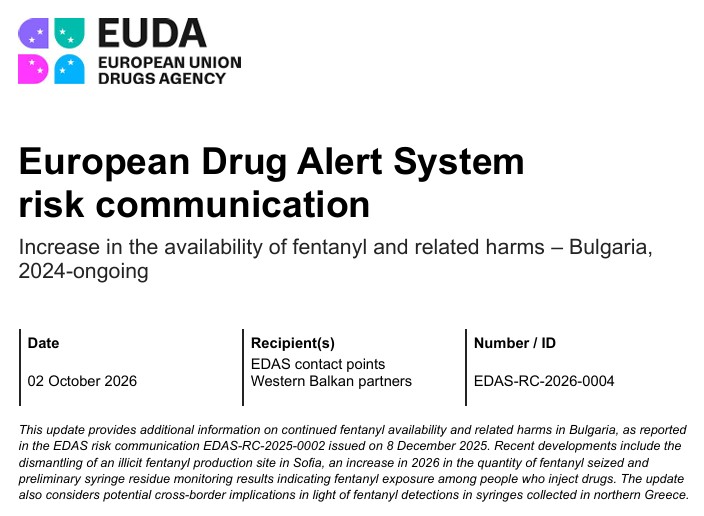
On October 2, 2026, the European Drug Alert System (EDAS) issued a risk communication regarding the deepening fentanyl problem in Bulgaria. It supplements the alert signal by EDAS on December 8, 2025.
The document addresses the fentanyl problem in Bulgaria from several points:
- The increased supply of fentanyl and law enforcement efforts to curb its distribution. Notable events include the discovery of a laboratory for the substance’s production in Sofia in August, as well as the large quantity of fentanyl seized in the country—approximately 20 kg during the first eight months of the year, according to field tests conducted.
- An increase in fentanyl-related deaths has been observed in recent years: 5 in 2023 (out of a total of 47), 53 in 2024 (out of 127), and 58 in 2025 (out of 125). Preliminary data for the first eight months of this year show 25 fentanyl-related deaths (out of 90).
- Increase in fentanyl use. According to data from a study conducted in July on the detections in syringe residues, fentanyl was detected in 94% of the 152 used syringes analyzed in Plovdiv, as well as in over 17% of the 150 used syringes analyzed in Sofia.
In connection with the above, the EU Drugs Agency makes recommendations for response and action required by Bulgaria:
Strengthen overdose prevention and harm reduction interventions in close cooperation with healthauthorities, tailored to national needs and legal context. These may include:
- Access to OAT for people with opioid dependence, including provisional arrangements to lower barriers to initiate and to continue OAT during an increase in fentanyl-related deaths, and access to needle and syringe programmes for people who inject drugs.
- Availability and distribution of naloxone and overdose response training.
- Brief interventions for people presenting to emergency departments with drug-related problems, particularly following an overdose.
- Targeted harm reduction awareness raising in risk areas, including referral to harm reduction services.
- Strengthen low-threshold and outreach interventions, including mobile and peer-led services, to reach people who use drugs who are not in contact with treatment and harm reduction services.
Strengthen monitoring and surveillance through national early warning systems by implementing a multi-indicator approach that integrates statistical data, such as forensic and customs seizures and toxicological analyses, with complementary data sources.
Establish or strengthen multi-stakeholder coordination mechanisms. This may involve public health authorities, healthcare providers, law enforcement agencies, customs, forensic and toxicology laboratories, harm reduction services, civil society organisations and people who use drugs to support information exchange and coordinated responses.
Improve the intelligence picture on fentanyl supply, including its sources, physical forms and
trafficking routes. This includes close cooperation with law enforcement authorities, particularly customs, and enhanced exchange of operational and strategic information between international partners on seizures, new modi operandi and concealment methods.